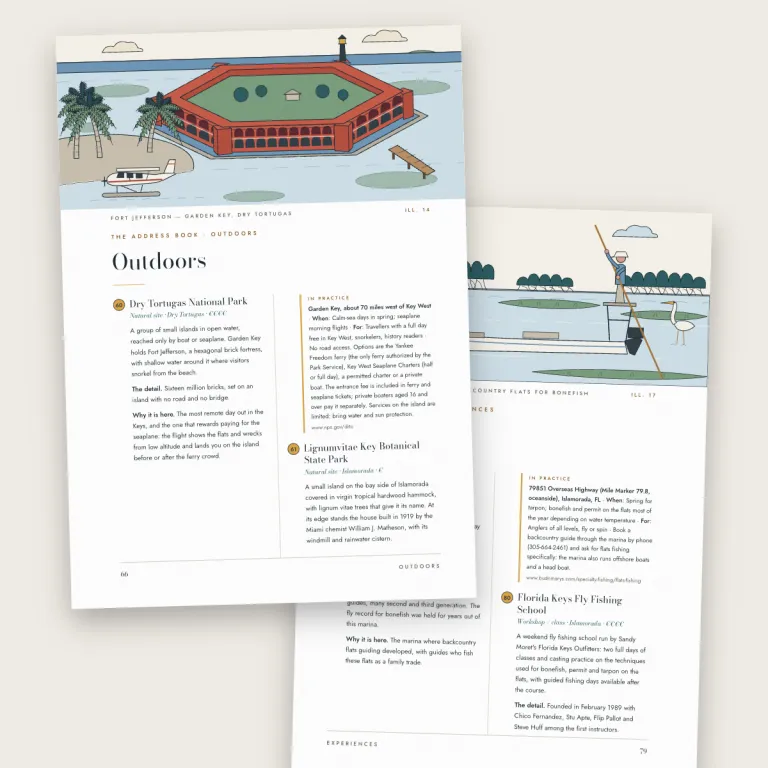
The Florida Keys are a line before they are a place, and the line runs over water. The Overseas Highway covers 113 miles from Key Largo to Key West on 42 bridges, laid on the right-of-way of the railway Henry Flagler pushed to Key West on 22 January 1912. Nobody here gives an address by neighbourhood; they give it by mile marker. Our 2026 guide to the chain is out, and it is built the same way: mile by mile, stretch by stretch.
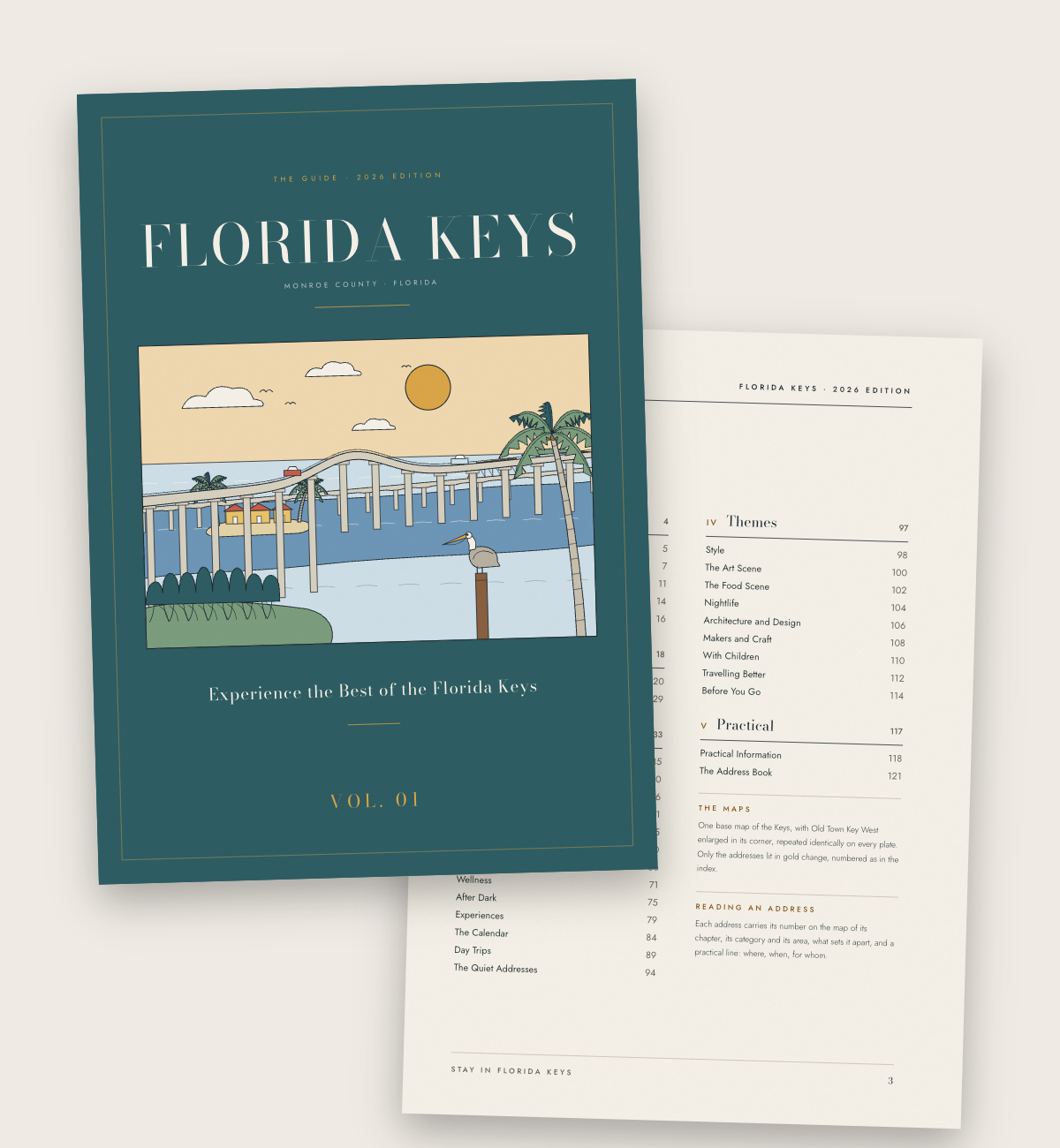
What is inside
123 plates. 105 numbered addresses, from a 30-suite private island off Little Torch Key to a bar behind an unmarked door in Key West. 20 maps. 30 illustrations. Three itineraries. Five parts: the opening, the territory, the address book, the themes, and the practical chapters.
The address book is the heart of it: 10 hotels, 12 restaurants, 8 bars, 6 places for coffee and early hours, 10 shops, 13 entries for culture and heritage, 8 outdoors, 5 for wellness, 6 after dark, 8 experiences, 8 dated events, 6 day trips, and 5 quiet addresses for travellers who already know the chain.
Six stretches rather than one island chain
The Keys have no centre, and that is the first thing the guide does something with. The islands are cut into six stretches, and the addresses of the book are spread across them as they really are: Key Largo 8, Islamorada 19, Marathon and the Middle Keys 6, Big Pine and the Lower Keys 10, Key West 55, the Dry Tortugas 1.
Key West holds more than half the book, which is a fact about the destination and not an editorial preference. Islamorada comes next, because the backcountry flats are there. Where to sleep is the first real choice of the trip, and each stretch changes the reason for coming.
Twenty maps on a single base map
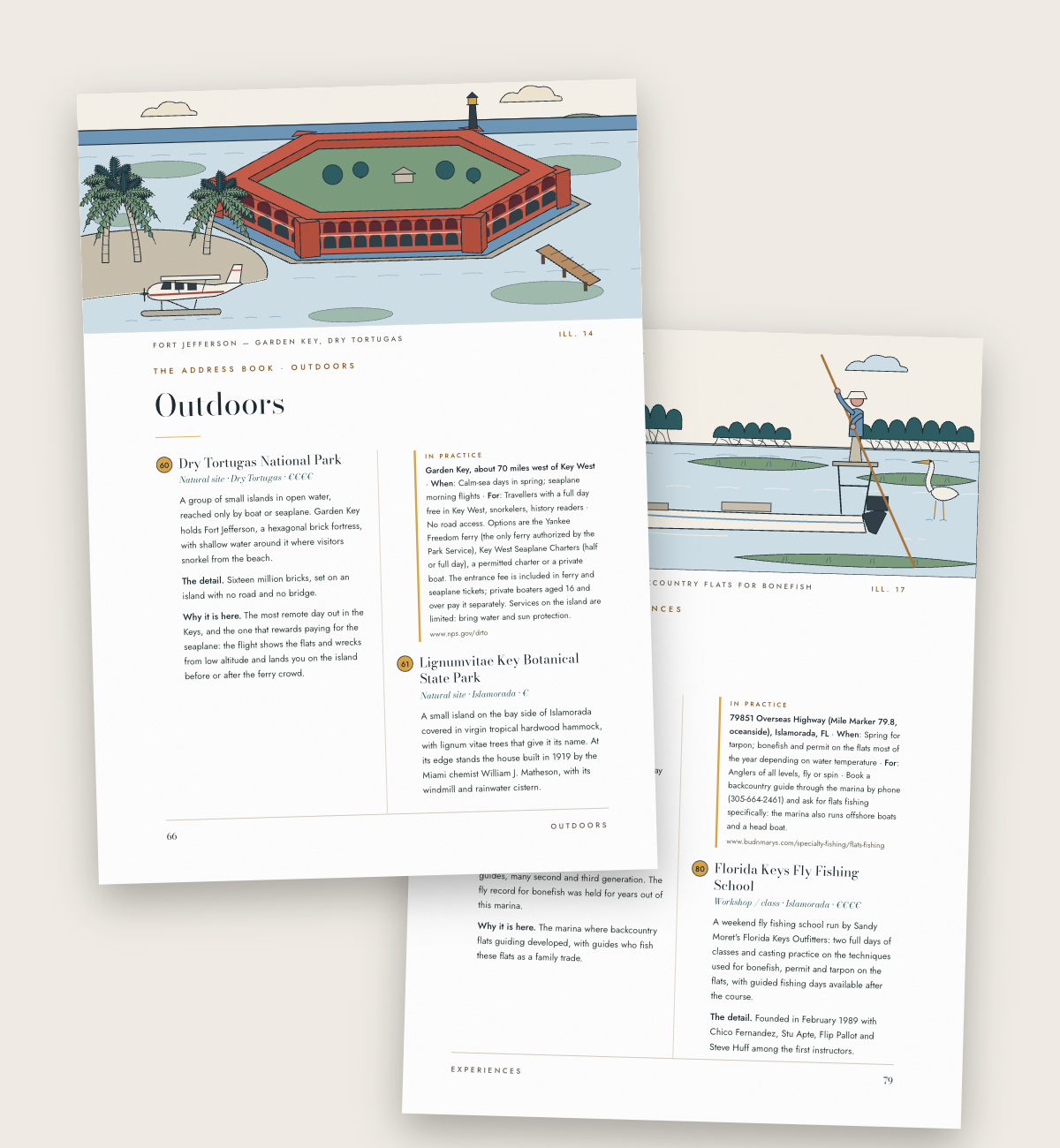
Every map in the guide is the same drawing of the chain, with Old Town Key West enlarged in its corner, repeated identically plate after plate. Only the addresses lit in gold change, numbered as in the index. One map shows the whole book, one per stretch, one per chapter of addresses.
The point is to be able to read the chain without relearning a new map each time. On the Where to Stay plate, ten numbers spread over 113 miles say more about the destination than any paragraph: there is no resort district, there are islands.
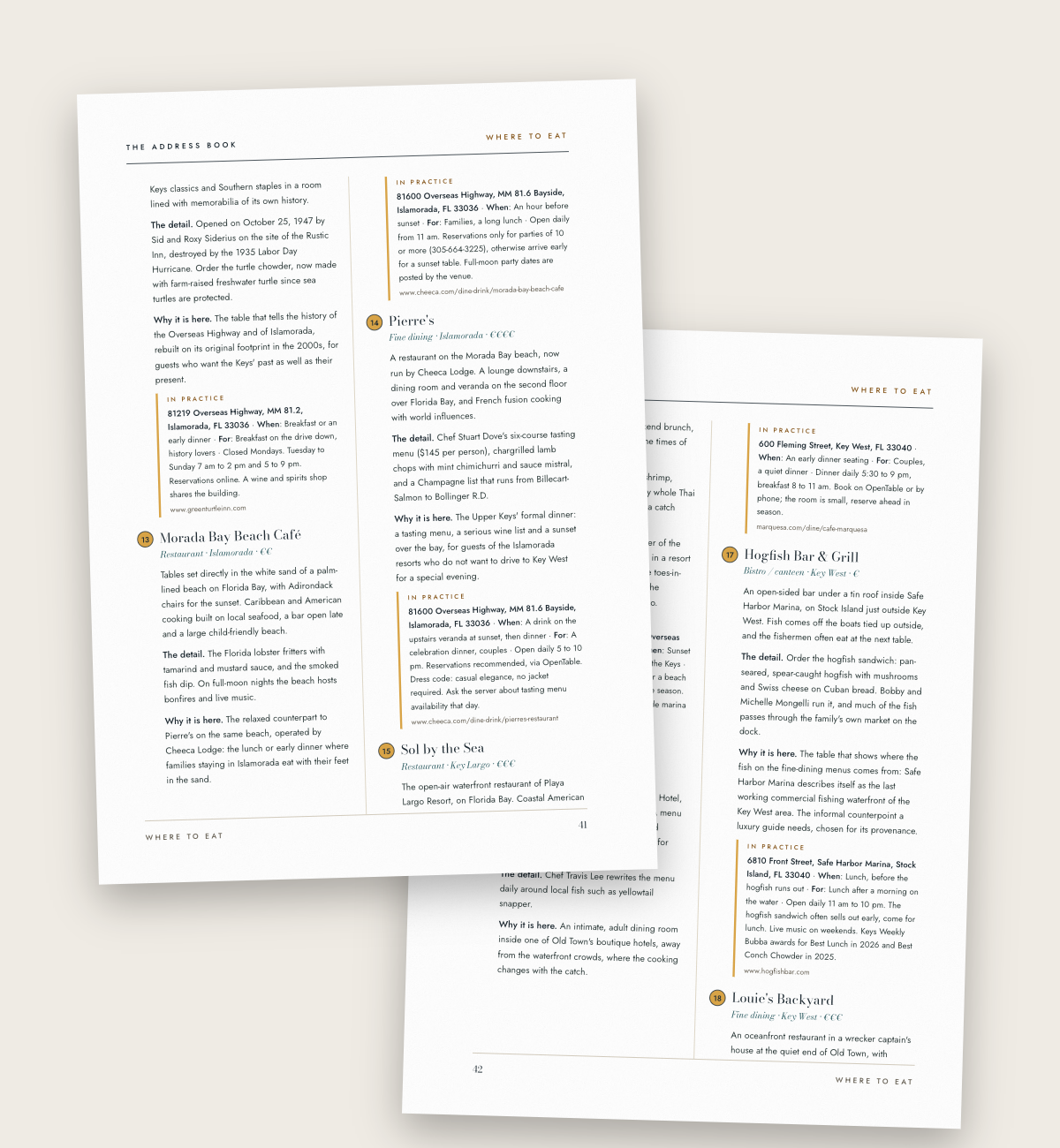
Every address says why it is here
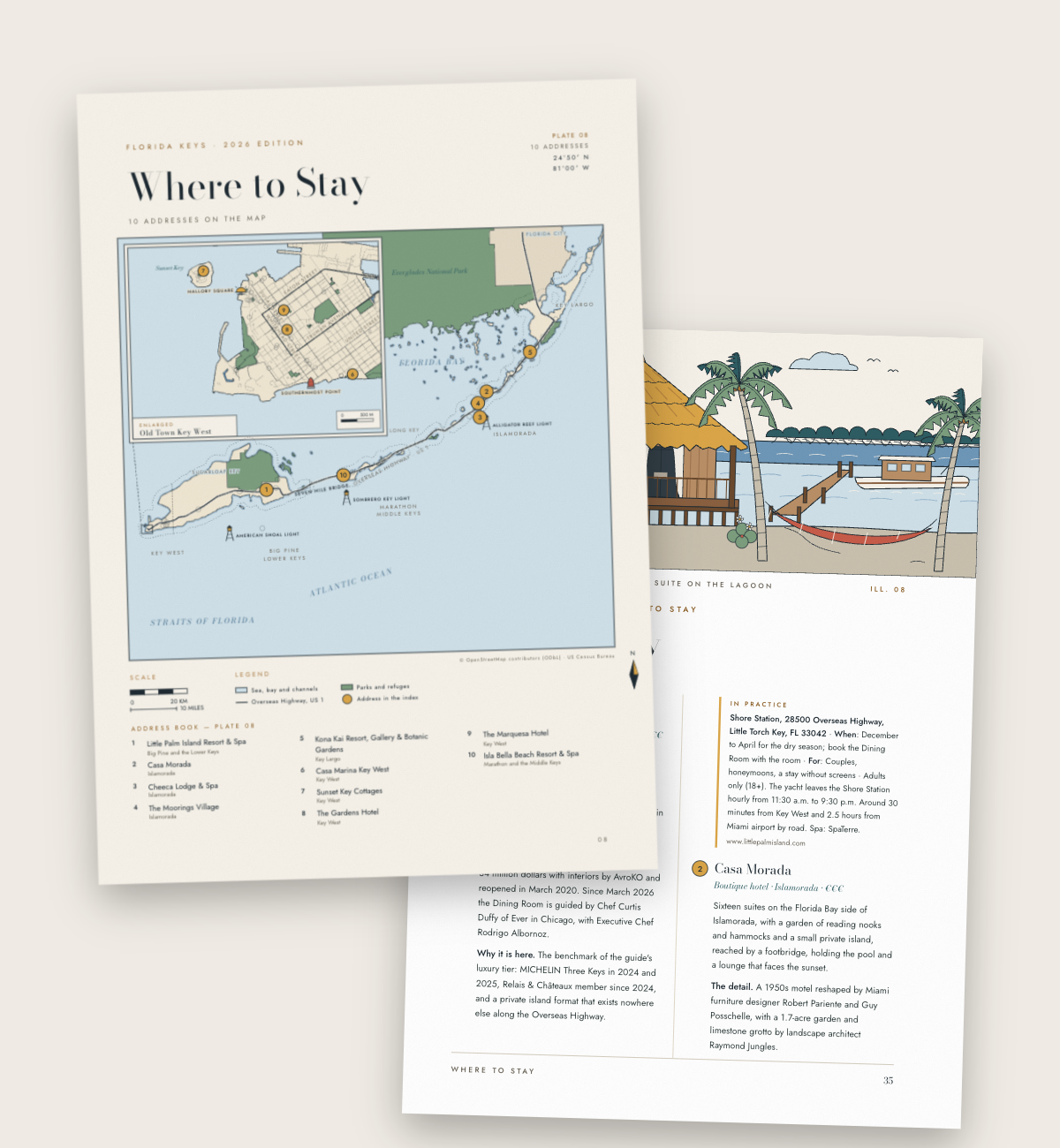
Each entry carries its number, its category, its stretch, a detail that sets it apart and a line that says why it is in the guide, then a practical block: where, when, for whom. Little Palm Island is there as the benchmark of the luxury tier — MICHELIN Three Keys in 2024 and 2025, Relais & Châteaux since 2024, rebuilt for 34 million dollars after Hurricane Irma and reopened in March 2020. Hogfish Bar & Grill is there for the opposite reason: an open-sided bar under a tin roof at Safe Harbor Marina, where the fish comes off the boats tied up outside and the fishermen eat at the next table.
A guide that only listed the first kind would be a rate card. A guide that only listed the second would be a blog.
Three itineraries, built only from the addresses in the book
- Two days in Key West, Old Town on foot and a day at sea. No car on either day.
- Five days from Islamorada to Little Palm Island: the flats, the bay, then a four-acre private island reached by the yacht that leaves the shore station at mile marker 28.5.
- Ten days from mile marker 127 to mile marker 0, the whole chain over five bases, so that no day is spent only on the road.
Times, opening days and seasons are those published by each address, with the reservations that have to be made weeks ahead marked as such: the Dry Tortugas ferry, the Latitudes table, the backcountry guide.
What it leaves out
Long white beaches, mainly. The only living coral barrier reef in the continental United States breaks the swell before it reaches the islands, and without waves there is little sand: the Keys are old coral turned to limestone. Bahia Honda is the exception people drive to. A traveller who comes for a beach has chosen the wrong destination; one who comes to be on the water — 4,539 square miles of national marine sanctuary, more than 6,000 species according to NOAA — has chosen well.
When to read it
Before booking rather than after. The year-end week is the sharpest peak of the year: on New Year's Eve 2022, county occupancy reached 95.6% at an average of $806 a night. The guide dates what can be dated — stone crab claws from October 15 to May 1, the lobster mini-season on 29 and 30 July 2026, the Key West Literary Seminar from 7 to 10 January 2027 — so that a trip can be built around the calendar instead of against it.